Next-Generation Technology Platform
To address the mining industry’s challenge of “making more metals with less”, Theia MetalsTM has developed a multi-disciplinary platform that unites proven technologies with proprietary innovations. The goal: to produce large volumes of target-specific peptides at industrial-scale cost.
Core Components
The Theia Metals' platform integrates four core components:

Phage Display Technology
to identify peptides that selectively bind target minerals or metals
Lab-Scale Assays
to evaluate peptide performance and optimise conditions for commercial success
Advanced Recombinant Manufacturing
to produce peptides cost-effectively at industrial scale
Novel Peptide Design Concepts
to improve binding strength and functionality for real-world conditions
Phage Display: The Engine Behind Peptide Selection
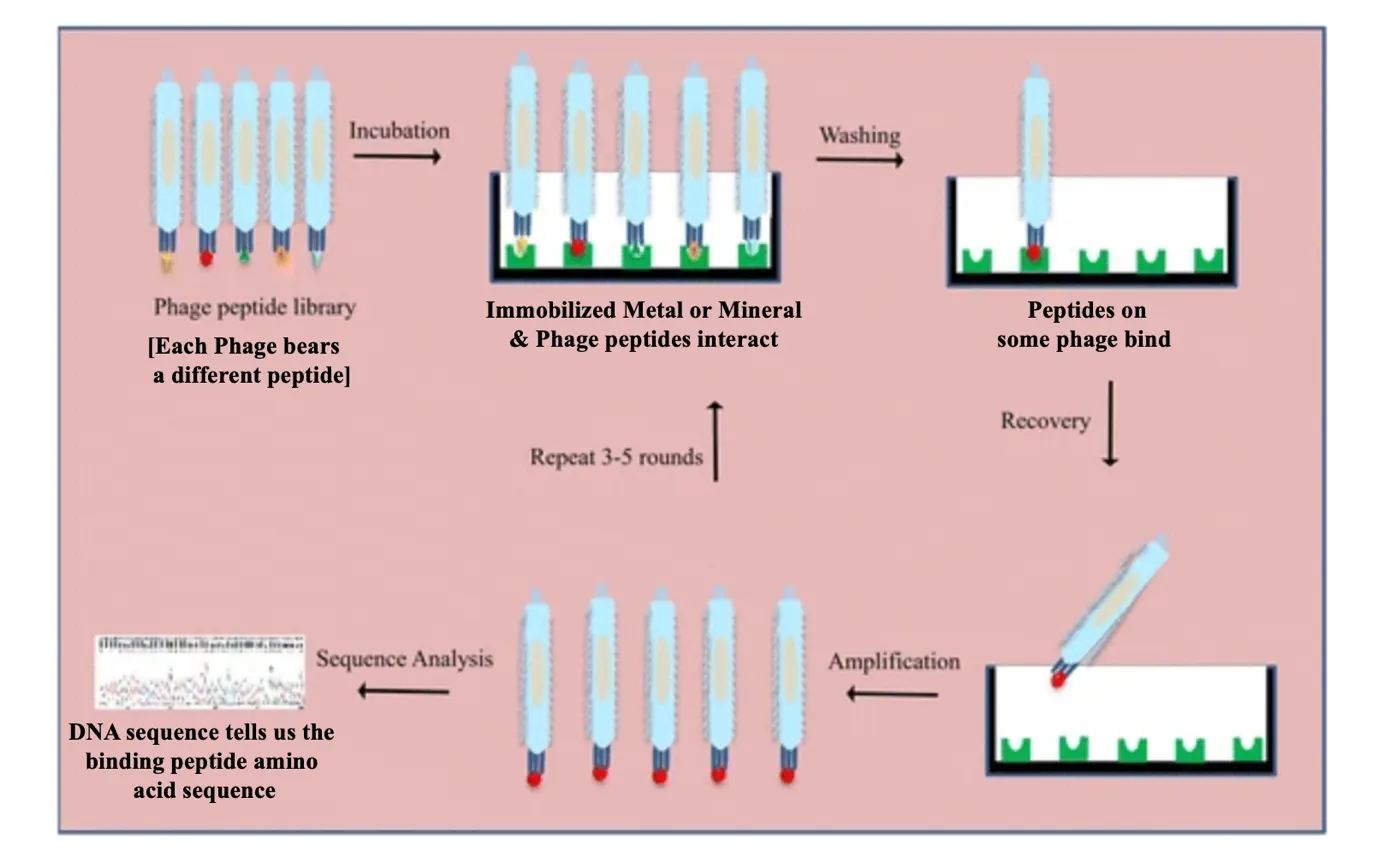
Phage display, developed in 1985 by George Smith, uses bacteriophages (viruses that infect bacteria) to express billions of peptide sequences on their surface. When exposed to a specific mineral or metal target, only the strongest binding phages are retained, amplified, and selected over multiple rounds. The DNA of these binding phages reveals the exact peptide structure for synthesis or further development.
This technique has been widely used across industries - resulting in commercial peptides for biotech, pharmaceuticals, food, cosmetics, agriculture, and biosensing. It’s proven that peptides can be made to bind virtually any surface, including metals and minerals.
Peptide Selection Using Phage Display - A large library of diverse peptides are generated on the surface of bacteriophage using a now classical process of Phage Display.
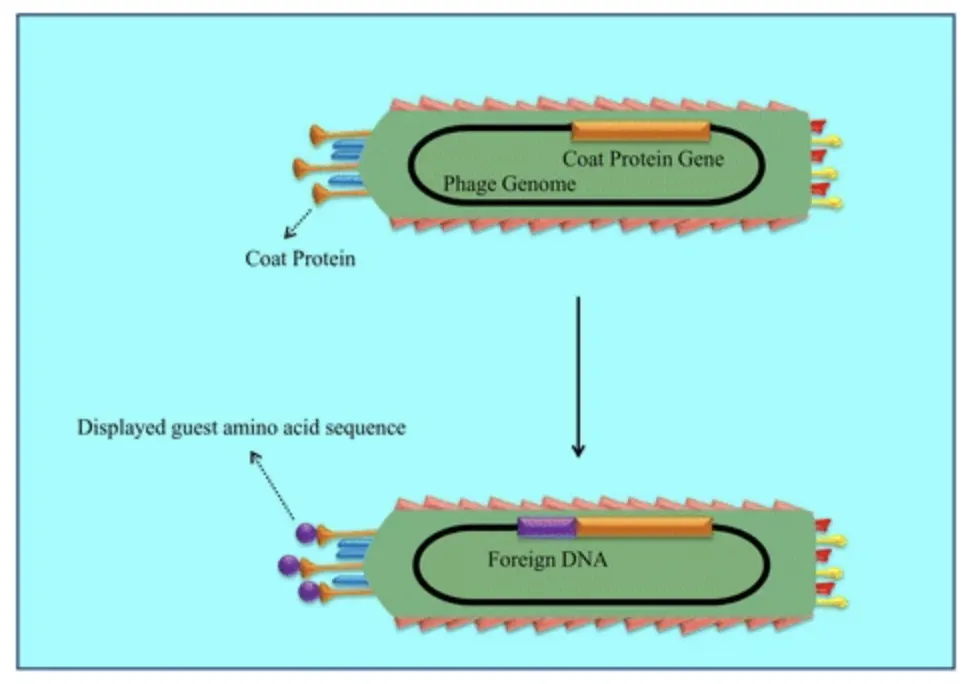
As shown above, each bacteriophage bears a particular short peptide sequence encoded by DNA inside the phage particle. The population of phage bearing a diverse library of peptide structures is then “panned” in sequential rounds for their ability to bind to the immobilised target metal or mineral (diagram below)
Peptides in Mining: Untapped Until Now
Since the first metal-binding peptide discovery in 1997, and further work in 2008–2018 identifying peptides for chalcopyrite and sphalerite, hundreds of mineral-specific peptides have been documented in academic literature. However, no peptide-based beneficiation process has reached pilot or commercial scale, primarily due to the high cost and limited scalability of solid-phase peptide synthesis.
Phage particles themselves are not suitable for industrial use, and until recently, peptide production at mining scale (kg - tonne quantities) was economically unfeasible.
Theia Metals' Breakthrough
Theia Metals bridges this gap by leveraging:
Recent breakthroughs in recombinant peptide production - dramatically lowering cost at scale
Innovative particle-peptide presentation formats - making separation and reuse practical
Through these advances, Theia Metals enables mining to finally benefit from the molecular specificity, diversity, and environmentally friendly nature of peptides - transforming the way minerals and metals are separated.